Plasma eyelid lift
Plasma points that tighten the eyelid without cutting or stitching. The most visible recovery in the centre, and we say so before you book.
How it worksPlasma points that sublimate the most superficial layer and contract the surrounding skin, with no cutting and no sutures.
- Rhythm
- A one-off session, sometimes in stages; repeating is assessed by how your skin responds.
- Back to normal
- The most visible here: swelling and crusting on show for a few days.
- Price
- Agreed at the free assessment. Why there is no fixed price list →
What it is
The plasma pen does not touch the skin: it creates a small plasma arc between the tip of the device and the surface, and that arc sublimates — evaporates — a microscopic point of the most superficial layer. By making a grid of points, the surrounding tissue contracts immediately and the repair process starts, which brings firmness over time.
On the eyelid, that contraction is what produces the more open gaze: excess skin length is taken up, with no cutting and no stitches. That is why it is called a non-surgical blepharoplasty — although it is worth understanding exactly what that "non-surgical" means.
It is the treatment here with the most visible recovery, and that has to be said upfront: every treated point forms a small dark crust, and those crusts are there for a few days, in plain sight. The real case published on this site shows exactly what that process looks like, unvarnished.
Who it is for
- Upper eyelid with mild or moderate excess skin
- A tired look from a drooping eyelid
- Bags and fine lines on the lower eyelid, depending on the case
- Anyone who does not want, or cannot have, surgery
- Anyone who can afford a few days with visible crusting
Better to wait, or to check first, if…
- Pregnancy and breastfeeding
- A tendency to keloids or hypertrophic scarring
- Higher phototypes and skin prone to hyperpigmentation: there is a real risk of a post-inflammatory patch and it is assessed very carefully
- A recent tan, or sun exposure coming up that you cannot avoid
- Uncontrolled diabetes, active autoimmune disease, immunosuppressive treatment or ongoing cancer treatment
- Current or recent isotretinoin
- Active infections and a herpes flare-up: around the eye, a history of herpes has to be discussed with your doctor first
- Eye conditions under treatment, recent eye or eyelid surgery, and severe dry eye: your ophthalmologist first
- Anticoagulant treatment or clotting disorders, without your doctor’s go-ahead
- Epilepsy and known allergy to topical anaesthetics
- Recent fillers, threads or botulinum toxin in the area: margins have to be respected
- A pacemaker or other implanted electronic devices
- Significant excess skin, or an eyelid falling over your vision: that calls for a surgical assessment, and telling you so is part of the job
This is the technique here with the most contraindications and the most visible recovery. If the assessment says you are not a good candidate, the answer is no.
The session, step by step
- 01
A thorough assessment
We study how much excess skin there is, your skin type and your tendency to pigment, and decide whether you are a candidate. We also decide how many stages it makes sense to plan.
- 02
You are told about the recovery
Before booking, we explain and show you how the area looks during the crusting days. Unvarnished, so you choose the date with your eyes open.
- 03
Topical anaesthetic
Anaesthetic is applied and left to work. In this area the waiting time matters.
- 04
The grid of points
We work point by point following a pattern and respecting the distance between points: that is what avoids healing problems.
- 05
Calming and aftercare
The area is calmed and you take away, in writing, the protocol for the crusting days — the part that decides the result.
What it feels like
With the anaesthetic you feel heat and brief pinpricks, with a small click at each point. There is a characteristic smell. Afterwards the area is hot and swells considerably: the swelling of the eyelid is dramatic in the first few hours and that is expected.
Before and after
Before you come
- No sun or sunbeds in the weeks before, and no fake tan
- Choose the date carefully: you will spend a few days with visible crusting
- Come without makeup and without contact lenses in
- Stop retinol and acids in the area in the days before
- If you are prone to cold sores, discuss it with your doctor first
After the session
- Do not touch, scratch or pick the crusts. They have to come off on their own: picking them is the number one cause of marks and scars
- Keep the area clean and dry as instructed
- No makeup over the area until the crust has come off
- No sun, pool, sauna, gym or sweating while the process lasts
- High, consistent sun protection afterwards, for a good while: that is what stops a patch forming
- Sleep with your head slightly raised the first few nights if the swelling is heavy
When you see it
The process has stages: swelling, crusting and then new, pink skin that gradually evens out in tone. The result is judged once the skin has fully recovered, and more than one session is often planned to gain ground safely rather than forcing it in one.
What it does not do
- It is not a blepharoplasty and does not give that result: if you have a lot of excess skin, this will fall short and you will be told so
- It does not remove fat pads: if the bag is herniated fat, this does not solve it
- It does not lift a dropped brow, which is often the real cause of a heavy eyelid
- It is not a treatment without recovery: the crusting days are part of the deal
- It is not for every skin: on skin prone to pigmenting, the risk of a patch is real
Also in Cold plasma / plasma pen
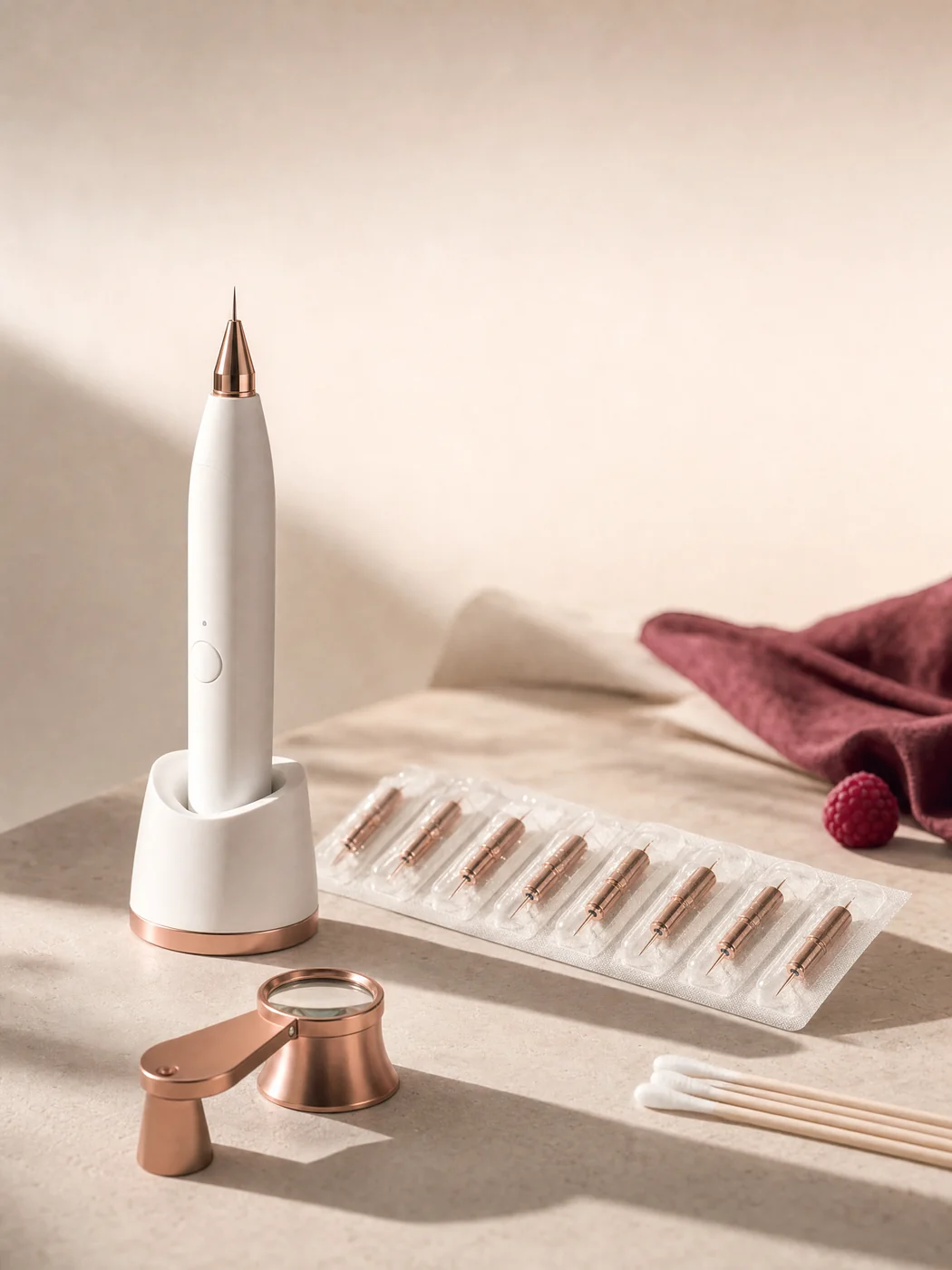
Plasma · lesions
Warts, skin tags and surface marks removed point by point with plasma — always after a doctor has seen the lesion. Moles are not treated here.
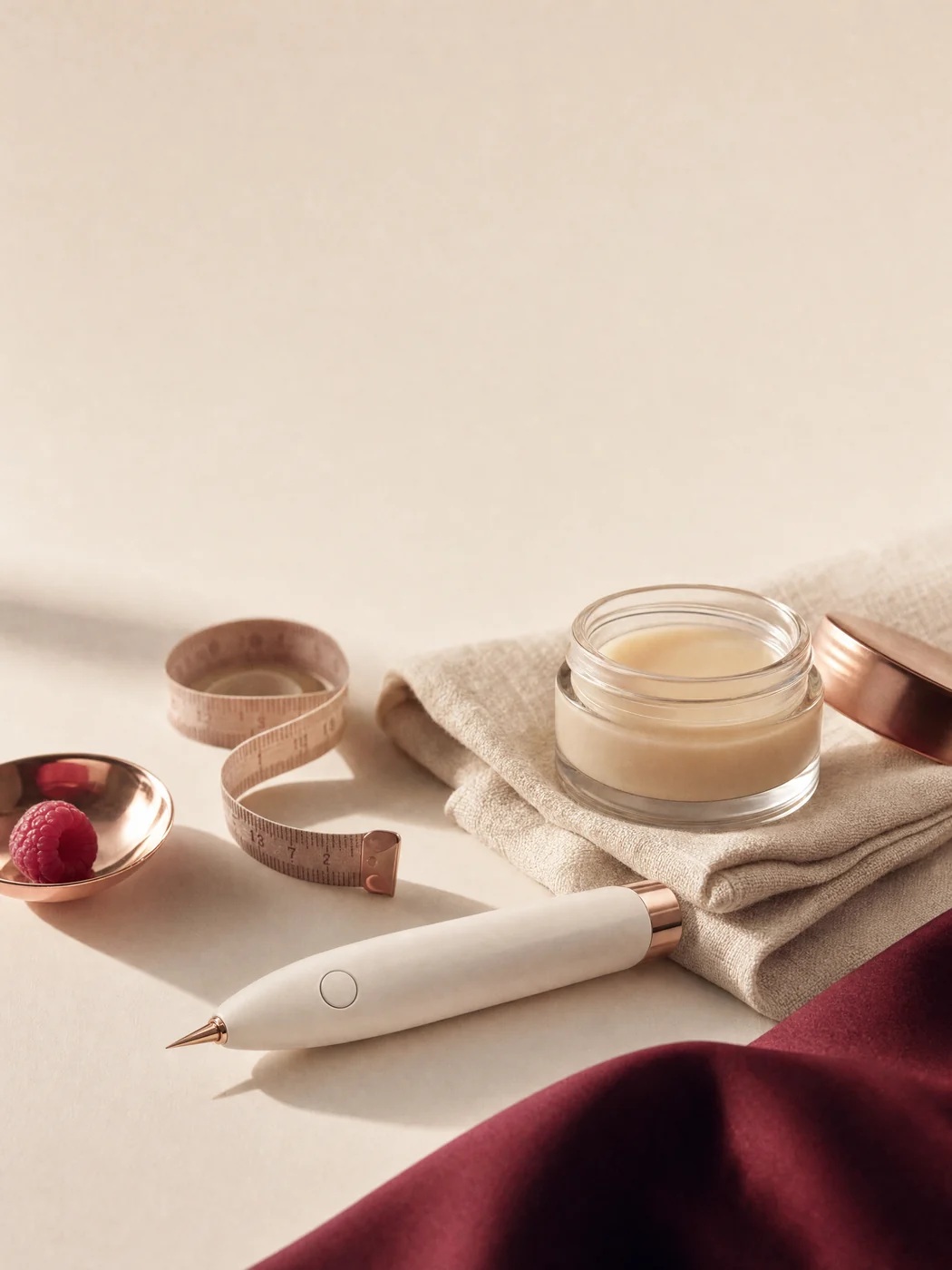
Plasma · tightening
A grid of plasma points to tighten lines on the forehead, lip and neck, and to work on mature stretch marks. Stretch marks are scars: they improve, they do not disappear.